
Views: 0 Author: Site Editor Publish Time: 2025-11-04 Origin: Site
Hey there, have you ever wondered why some medical devices seem almost magical? Like, how can a tiny wire inside your body remember its shape and spring back to life without a hitch? That's the wizardry of nitinol wire, folks—a nickel-titanium alloy that's basically the superhero of the medical world. At DLX Alloy, we've been knee-deep in crafting this game-changer for years, and today, I'm pulling back the curtain on why nitinol wire is the go-to for everything from heart stents to orthodontic braces. If you're in medtech, a curious patient, or just geeking out on materials science, stick around. We'll dive into its properties, real-life uses, and even pit it against other alloys to see why it wins every time. By the end, you'll see why partnering with a pro like DLX Alloy for your superelastic nitinol wire needs is a no-brainer.

Picture this: You're in the OR, and the surgeon needs a device that can snake through your arteries like a flexible eel, then snap into place perfectly. Enter nitinol wire—the shape memory alloy (SMA) that's transforming healthcare one bend at a time. Born from nickel and titanium, this wire isn't just tough; it's smart. It remembers its original form, bounces back from crazy deformations, and plays nice with your body's tissues. No wonder the medical industry can't get enough.
But why nitinol specifically? In a sea of metals, it stands out for minimally invasive procedures that mean smaller scars, quicker recoveries, and happier patients. And here's the kicker: At DLX Alloy, we don't just supply nitinol wire; we customize it for precision medical applications, ensuring every strand meets the highest standards. Whether it's shape memory nitinol wire for implants or superelastic nitinol wire for guidewires, we're your reliable partner. Let's unpack why this alloy is rewriting the rules of medicine.
Okay, let's start at the beginning. If nitinol sounds like a sci-fi gadget, you're not far off—it's named after Nitinol Naval Ordance Laboratory, where it was discovered in the 1960s. But forget the lab coat vibes; nitinol wire is as practical as it gets in modern medicine.
 At its core, nitinol wire is a near-equal mix of nickel (about 55%) and titanium (45%). This combo creates a unique crystal structure that flips between austenite (stiff and straight) and martensite (soft and bendy) phases based on temperature. It's like having a wire with a split personality—one that's rigid when you need strength, pliable when you need flexibility. What makes DLX Alloy's nickel titanium nitinol wire special? We source premium raw materials and control the alloy ratio down to the tiniest fraction, ensuring consistent performance every time.
Think of it as the Goldilocks of alloys: not too brittle like pure titanium, not too stiff like stainless steel. This balance is why medical nitinol wire from DLX Alloy is trusted in high-stakes devices—it's engineered for reliability, not just hype.
Making nitinol wire isn't a walk in the park; it's a high-tech ballet of melting, drawing, and heat-treating. We start by vacuum-arc melting the metals to avoid impurities, then extrude them into rods and draw them down to ultra-fine diameters—like 0.1mm for delicate guidewires. Heat treatment sets the "memory," and electropolishing gives it that smooth, biocompatible finish.
At DLX Alloy, our state-of-the-art facilities crank out superelastic nitinol wire with Af temperatures (austenite finish) tailored from -20°C to 50°C. Why does this matter? Because in medicine, one-size-fits-all doesn't cut it. Your catheter needs wire that activates at body temp—37°C—without fail. We've got you covered, with batches tested for tensile strength up to 1,000 MPa.
| Nitinol Wire Chemical Composition | ||||
Product Type | Grade | Fully Annealing Af | Form | Standard |
Shape Memory Nitinol Wire | NiTi-01 | 20℃~40℃ | Wire, Bar, Plate | Customer specified or Industry Standard (ASTMF2063 Q/XB1516.1 Q/XB1516.2) |
| NiTi-02 | 45℃~90℃ | |||
| Superelastic nitinol alloy | Ni-Ti-SS | -5℃~5℃ | ||
| Low temperature superelastic nitinol alloy | TN3 | -20℃~-30℃ | ||
| TNC | ||||
| Medical nitinol alloy | NiTi-SS | Active Af 33℃±3℃ | ||
| Narrow hysteresis nitinol alloy | NiTiCu | As-Ms≤5℃ | Wire, Bar | |
| Wide hysteresis nitinol alloy | NiTiNb | As-Ms<150℃ | ||
| NiTiF | ||||
Alright, let's geek out on what makes nitinol wire tick. It's not just metal; it's material magic with properties that scream "future of healthcare."
Ever seen a wire that's crushed flat but pops back like it never happened? That's the shape memory effect (SME) in action. Cool the nitinol wire below its martensite start temp, deform it wildly (up to 8% strain), then warm it up—bam, it springs to its pre-set shape.
Imagine deploying a stent: Compressed into a tiny catheter, it travels through your veins, then body heat triggers the SME, expanding it to prop open an artery. No bulky tools, no big cuts. DLX Alloy's shape memory nitinol wire is optimized for this, with hysteresis loops so tight they ensure deployment every time.
Superelasticity, or pseudoelasticity, lets nitinol wire stretch up to 10% and snap back without heat. It's active at body temperature, making it ideal for dynamic environments like beating hearts.
In a twisting guidewire, superelastic nitinol wire navigates curves that would snap lesser metals. Patients feel less pain, surgeons get better control. Our DLX Alloy versions boast recovery rates over 95%, turning what could be a rigid ordeal into a smooth sail.
Here's the trust factor: Nitinol wire doesn't rust, leach toxins, or spark allergies in most folks. Its oxide layer shields it from corrosion, even in salty blood.
Saltwater? Acidic fluids? No sweat. Medical nitinol wire lasts decades without degrading, unlike alloys that pit and fail. DLX Alloy subjects every coil to ASTM F2129 testing, guaranteeing it's as safe as grandma's hug.
Medical devices pulse, flex, and endure millions of cycles. Nitinol wire handles 10^7 cycles at 4% strain—think heartbeats for years—without cracking. It's the marathon runner of wires.
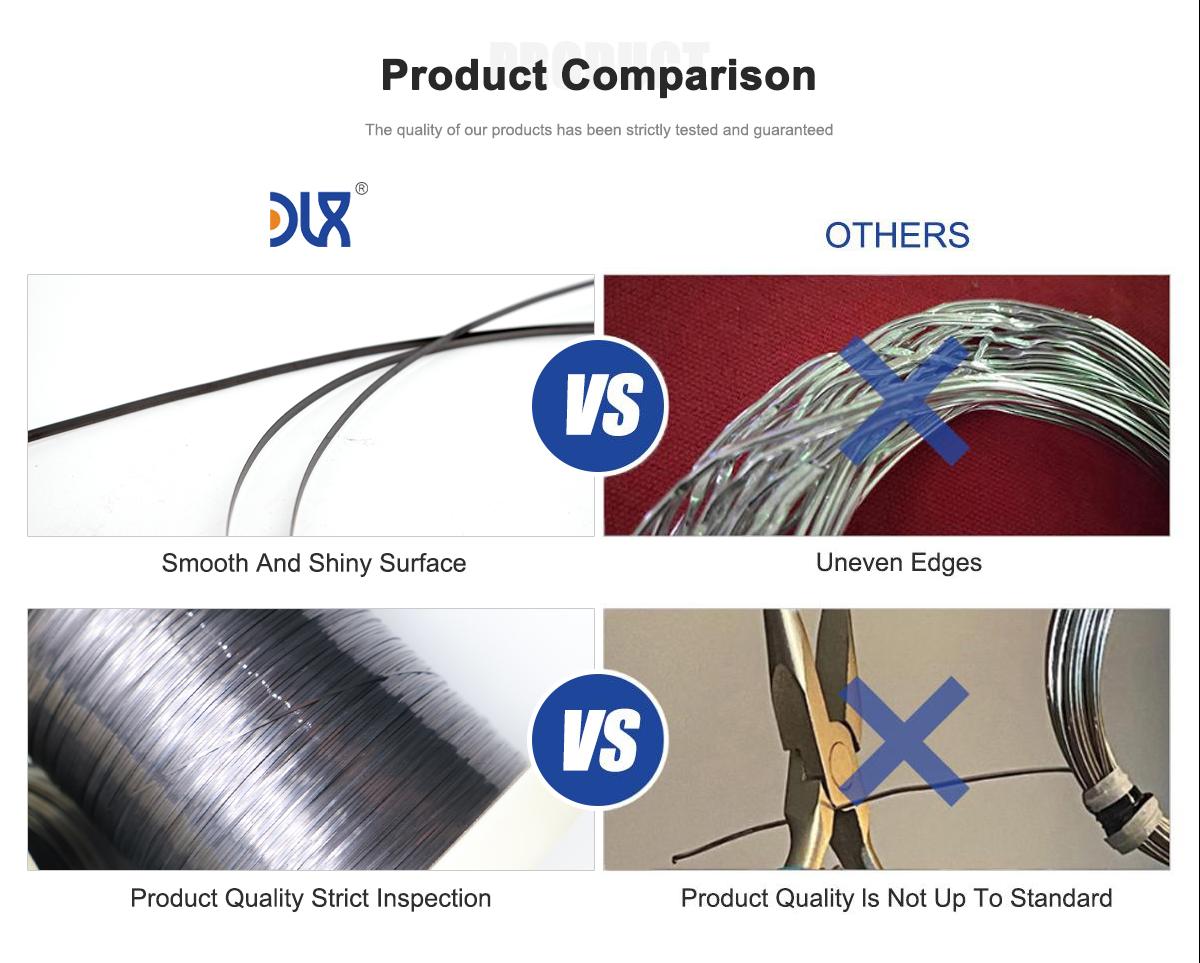
So, why bet on nitinol wire when shelves groan with alternatives? Simple: It slashes risks, boosts outcomes, and saves bucks long-term. Let's break it down.
Big incisions? Ancient history. Nitinol wire packs power into petite packages, letting docs thread devices through pinholes.
From dental aligns to neuro clips, nitinol wire delivers exact forces—gentle yet firm.Customizable for Specific Patient Needs.
Studies show nitinol cuts reoperation rates by 30%.Reducing Long-Term Healthcare Expenses.Hospitals love our nitinol wire because it pays off—literally. One less emergency stent swap saves thousands.
Time for the cage match: Nitinol wire versus the competition. Spoiler: It flexes its way to victory.

Stainless steel's tough and cheap, but stiff as a board—great for screws, lousy for curves.
Nitinol wire bends 8x more without kinking, ideal for vascular work. Stainless fatigues fast in flexy spots; nitinol laughs it off with 100x better cycles. DLX Alloy's nickel titanium wire outshines in endurance tests.
Pure titanium's light and strong, but no memory tricks.
Titanium stays put; nitinol wire self-adjusts post-implant. For orthopedic plates, nitinol compresses fractures dynamically—titanium just sits there. Our superelastic grades at DLX Alloy add that extra snap.
| Alloy Type | Flexibility (Strain Recovery) | Biocompatibility | Fatigue Life (Cycles) | Best For | Feature |
|---|---|---|---|---|---|
| Nitinol Wire | Up to 10% | Excellent (Low Ni release) | 10^7+ | Dynamic implants, guidewires | Custom Af temps, ultra-fine diameters |
| Stainless Steel | <1% | Good | 10^5 | Static fixtures | N/A – Too rigid for DLX med focus |
| Titanium Alloys | 2-4% | Excellent | 10^6 | Lightweight prosthetics | N/A – Lacks SME |
| Cobalt-Chromium | 1-2% | Excellent | 10^6 | High-load stents | N/A – Brittle vs. superelasticity |
Theory's cool, but let's see nitinol wire in the wild—saving lives, one coil at a time.
Not all nitinol wire is created equal—quality's your lifeline.
ISO 13485, ASTM F2063? Must-haves. DLX Alloy ticks them all, with FDA-compliant processes.
From 0.03mm filaments to 2mm rods, we tailor medical nitinol wire to your specs—surface oxide for visibility, electropolish for stealth.
 Let's talk : At DLX Alloy, we're more than suppliers—we're innovators crafting nitinol wire since our titanium roots in Changzhou, China. With global reach and 20+ years honing alloys, we specialize in superelastic nitinol wire for medical devices and shape memory nickel titanium wire.
From orthodontic arches to vascular stents, our wire's in 100+ devices worldwide. We control every step—melting to packaging—for purity >99.5%.
Need low-Ni for sensitive patients? We've got variants. Our R&D team collaborates, turning your prototype into production gold.
We invest in testing. Fast lead times (2-4 weeks), competitive pricing, and eco-friendly sourcing make us the smart pick. Connect us to see our nitinol wire lineup—your next med breakthrough starts here.
X-ray fluoresced, tensile-tested. We're pushing boundaries, like hybrid nitinol-titanium blends for next-gen implants.
Picking nitinol wire? Don't wing it—focus on these.
Thin for guides (0.1mm), thicker for stents (0.5mm). Af at 20-40°C for body activation. Surfarce? Reduces friction 30%.
DLX Alloy ships worldwide, with traceability from melt to meter. No delays derailing your trials.

The horizon's bright for nitinol wire. 3D-printed scaffolds? Already prototyping at DLX Alloy.
Layer-by-layer nitinol implants, personalized to your CT scan—revolutionizing orthopedics.
Sensor-embedded nitinol wire that texts your doc on stress levels? Coming soon, with our flexible alloys leading the charge.
Whew, what a ride through the world of nitinol wire! From its shape-shifting smarts to unbeatable biocompatibility, it's clear why the medical industry leans on this alloy for life-changing tech. Whether flexing through arteries or aligning teeth, superelastic nitinol wire and shape memory variants deliver precision where it counts most. And with DLX Alloy in your corner, sourcing top-tier nickel titanium nitinol wire becomes effortless—custom, compliant, and cutting-edge. Ready to elevate your med devices? Contact Us !Your breakthrough awaits.
Factory Direct Supply with Competitive Wholesale Prices
Custom Sizes & Large Stock Availability
Fast Global Shipping & Reliable Industrial Supply
Offer samples of Nitinol superelastic wire available.
Delivery for Nitinol wire typically takes 7–20 days for small orders and 20–60 days for bulk superelastic Nitinol wire, depending on specifications and quantity.
Yes, we fully support OEM/ODM production for Nitinol wire—simply share your samples or drawings to receive customized superelastic Nitinol wire solutions.
We provide flexible payment options for Nitinol wire orders, including T/T, L/C, D/P, Western Union, MoneyGram, and PayPal.
Yes,superelastic Nitinol wire samples for orthodontic and medical device testing.


