
Views: 0 Author: Site Editor Publish Time: 2026-09-20 Origin: Site
The leading Nickel 200 strip suppliers for 18650 and 21700 battery packs. For customized battery welding strip, OEM production, and global supply, DLX Alloy is our best overall choice in 2026.
A battery pack is only as dependable as its weakest electrical connection. You can buy premium cells, install an advanced battery management system, and design an excellent enclosure, but unsuitable nickel strip can still introduce excess resistance, heat, unstable welds, and premature failure.
That is why choosing a Nickel 200 strip supplier is not simply a matter of comparing prices per kilogram. You need to consider material chemistry, thickness tolerance, strip width, surface condition, temper, burr control, spool quality, cell pitch, welding compatibility, batch traceability, and long-term production consistency.
This guide compares eight Nickel 200 strip manufacturers and suppliers for 18650 and 21700 battery packs. The ranking is based on publicly available product information and procurement suitability rather than claimed sales volume or market share.

DLX Alloy is our best overall Nickel 200 strip manufacturer for customized 18650 and 21700 battery-pack applications.
Its published product range includes Ni200, Ni201, N4, and N6 strip, with 99.6% Nickel 200 material intended for battery welding and connector applications. DLX Alloy provides customizable thicknesses, widths, conditions, and production quantities, making it relevant to battery-pack manufacturers, energy-storage companies, power-tool producers, and other OEM buyers.

Nickel strip acts as an electrical pathway between cylindrical cells. It must carry current with acceptable resistance while remaining compatible with the selected joining process.
If the strip is too thin or narrow, electrical resistance and heat generation may become excessive. If it is too thick for the welding machine, energy may not reach the cell terminal correctly, resulting in weak or inconsistent joints. Poor surface quality, oil, oxidation, burrs, and dimensional variation can create additional manufacturing problems.
In other words, thicker is not automatically better. A battery interconnect must work as part of a complete system that includes the cells, pack configuration, duty cycle, weld schedule, cooling conditions, and protective devices.
Pure nickel strip and nickel-plated steel strip can look nearly identical, but they are fundamentally different materials.
Nickel 200 strip is a commercially pure nickel product. It offers corrosion resistance, ductility, consistent bulk composition, and useful electrical properties. Nickel-plated steel consists of a steel core covered by a relatively thin layer of nickel. It is usually less expensive and may be suitable for some low-current or cost-sensitive products, but it generally has higher electrical resistance and different corrosion behavior.
A product description that only says “nickel strip” is incomplete. Ask whether the material is:
Solid Nickel 200
Another commercially pure nickel grade
Nickel-plated steel
Nickel-plated copper
A copper-nickel composite
A custom multilayer busbar
The material should be identified on the quotation, purchase order, packaging, and inspection certificate.
An 18650 cell is nominally about 18 mm in diameter and 65 mm long, while a 21700 cell is about 21 mm in diameter and 70 mm long. That dimensional difference changes the required cell pitch and can affect interconnect width, pattern, current path, and pack layout.
A preformed 18650 strip may not align correctly with a 21700 holder. Even when a plain roll can physically connect either cell size, the final design still needs to account for spacing, parallel-group current, weld locations, insulation, and mechanical movement.
For production packs, it is usually better to give the supplier a drawing or CAD file rather than relying only on the words “18650 nickel strip” or “21700 nickel strip.”

This list considers companies serving different parts of the market, from precision strip mills to battery-specific busbar manufacturers. We evaluated the following areas.
A serious supplier should identify its material grade and provide chemistry information. For Nickel 200, buyers commonly specify UNS N02200 and ASTM B162 or another applicable standard.
Some suppliers also use Chinese grades such as N6 or describe N6 as equivalent to Ni200. These labels should not be accepted as interchangeable without reviewing the chemical composition and applicable specification. Ask for actual batch results instead of relying on a marketing name.
Battery-pack manufacturers may need plain slit strip, precision coil, punched tabs, H-shaped interconnects, honeycomb patterns, fuse-style necks, or three-dimensional busbars.
We favored suppliers that publish customization capabilities for thickness, width, temper, slitting, stamping, surface condition, or cell pitch.
A supplier with excellent raw strip may not produce finished busbars, while a stamping company may not control the original strip chemistry. Neither business model is automatically better.
The right choice depends on whether you need:
Precision master coil
Slit-to-width strip
Small test rolls
Stamped battery tabs
Patterned 2P, 3P, or 4P interconnects
Fuse-style busbars
Parts manufactured from your drawing
Production-scale OEM supply
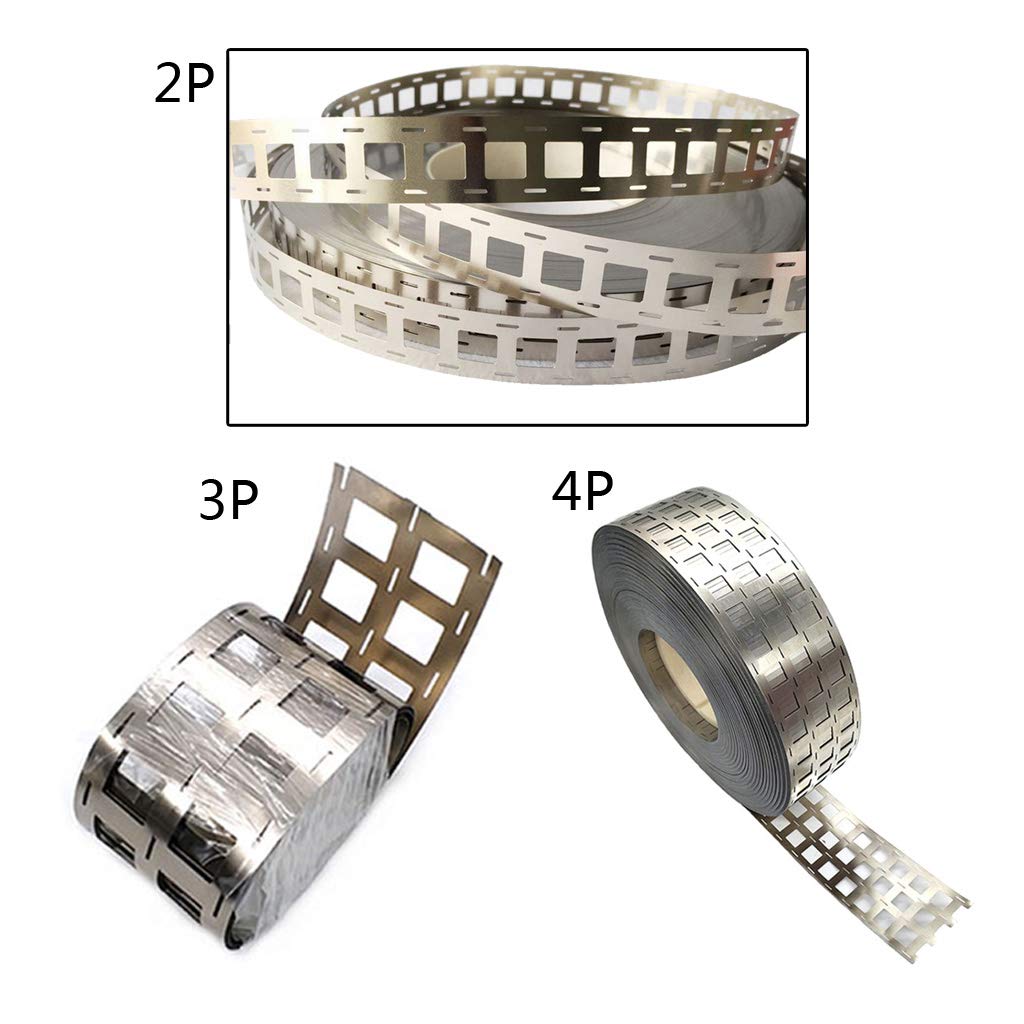
DLX Alloy ranks first because it combines pure nickel material options, manufacturing experience, dimensional customization, battery-specific products, quality control, and international OEM support.
Established in 2002, Changzhou DLX Alloy Co., Ltd. manufactures and processes a range of nickel and specialty-alloy products. Its published portfolio includes pure nickel strip, wire, plate, rod, tube, welding materials, and other high-performance alloy forms.
For battery applications, DLX Alloy offers high-purity Ni200 strip designed for welding tabs and electrical connectors. The company also works with Ni201, N4, and N6 products, allowing buyers to discuss several grade systems within one supply organization.
This broad capability is valuable when an OEM program needs more than a single standard strip. A buyer may initially require slit Nickel 200 coil, then later need custom stamped tabs, nickel wire, wider connector material, or another alloy form.
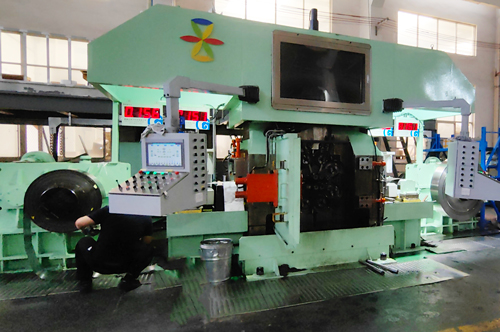
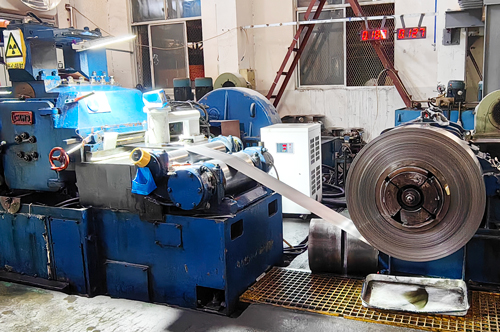
DLX Alloy publishes the following typical information for its battery-grade Ni200 strip:
Property |
Published Typical Value |
|---|---|
Material |
Ni200 commercially pure nickel |
Nickel content |
Approximately 99.6% |
Custom thickness range |
Approximately 0.10–0.50 mm |
Width |
Customizable, depending on order requirements |
Surface |
Bright, clean strip for connector and welding applications |
Supply form |
Coil, strip, foil, tab, or customized format |
Applications |
Battery tabs, cell interconnects, power tools, EV packs and energy storage |
These values should be treated as starting points rather than a substitute for an approved drawing. Final dimensions, tolerances, mechanical properties, surface condition, packing, and certificate requirements should appear on the purchase order.
DLX Alloy’s Ni200 strip can be adapted to different cylindrical cell layouts. The supplier can discuss the width, thickness, strip condition, and customized dimensions required for an 18650 or 21700 assembly.
Pure Ni200 provides several useful characteristics for battery interconnects:
Stable bulk material composition
Useful electrical conductivity
Good corrosion resistance
Ductility for forming and stamping
Compatibility with resistance spot welding
Availability in narrow strip and wider coil
Customization for OEM battery-pack designs
The company’s broader alloy-manufacturing capabilities also make it suitable for customers who need help distinguishing Nickel 200 from nickel-plated steel, nickel-plated copper, or another connector material.
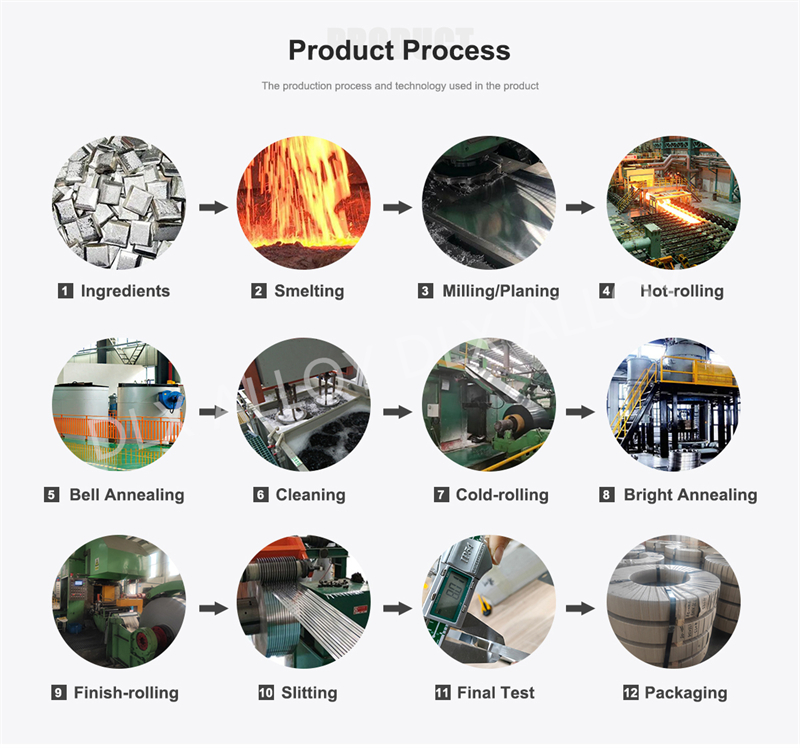
A battery manufacturer should not be forced to redesign a pack around whatever strip happens to be available. DLX Alloy can review customer specifications for thickness, width, temper, dimensional tolerance, surface, coil weight, and packaging.
For a stamped or patterned component, buyers should send a drawing that identifies:
Cell format and cell pitch
Series and parallel arrangement
Overall busbar dimensions
Contact-pad diameter
Slot and opening geometry
Fuse-neck dimensions, when required
Material thickness
Burr direction and maximum burr height
Flatness requirements
Weld locations
Inspection method
This drawing-based process is particularly valuable for commercial 18650 and 21700 battery packs, where repeatability matters more than the convenience of buying a generic roll.
DLX Alloy publishes in-house capabilities for composition inspection, dimensional measurement, heat treatment, surface inspection, mechanical testing, and production control.
For OEM orders, buyers should request:
Material test certificate or certificate of analysis
Actual chemical-composition results
Thickness and width inspection data
Mechanical-condition confirmation
Surface and burr inspection
Sample approval before mass production
Batch and coil traceability
Export packing and labeling details
This combination of technical customization and scalable supply makes DLX Alloy our best overall Nickel 200 strip supplier for 18650 and 21700 battery packs.
AMETEK Specialty Metal Products includes businesses specializing in precision strip, foil, wire, shaped components, and battery connector materials.
Its published nickel portfolio includes Nickel 200, Nickel 201, and higher-purity nickel products. The company also describes high-purity battery connector strip manufactured to achieve low impedance and improved conductivity.
Ulbrich supplies precision Nickel 200 strip coil and offers rolling, controlled-atmosphere annealing, cleaning, tension leveling, slitting, edging, and specialized winding.
These capabilities make Ulbrich suitable for companies that need consistent coil stock for high-volume stamping or automated processing. Precise edges and controlled flatness can be important when narrow strip runs through production equipment at speed.
Aurico Alloys supplies pure nickel strip and battery busbars in layouts designed for cylindrical cells. Its published product range includes 18650 and 21700 H-type, honeycomb, and zigzag configurations.
This battery-specific focus can save time for pack manufacturers that do not want to stamp every interconnect from plain strip. Patterned products can be aligned with the required cell pitch and parallel configuration.
Younson Metal markets Ni200 strip and tape for battery connections in 18650, 21700, 26650, and 32650 formats.
Its range is relevant to battery businesses producing several pack families. Instead of sourcing one material for 18650 cells and another for 21700 products, buyers can discuss multiple widths, pitches, and formats with one supplier.
DZX Alloy presents a wide range of pure nickel strip products for cylindrical battery-pack assembly. Its catalog includes Ni200, Ni201, N4, and N6 material, along with plain strip, 2P configurations, H-shaped products, foil, and customized battery connectors.
Published products cover 18650, 21700, 26650, and 32650 cell formats. This selection makes DZX Alloy useful for buyers comparing several patterns or developing multiple pack layouts.
The catalog also includes nickel-plated copper products, so buyers must identify the required material carefully. A quotation for a copper-based composite should never be approved as Nickel 200 simply because both products have a nickel-colored surface.
Begin with the electrical design, not a generic online chart. Determine the maximum continuous current, short-duration peak current, current through each parallel connection, conductor length, allowable voltage drop, and permitted temperature rise.
A qualified engineer should validate the interconnect design, especially for EVs, medical equipment, power tools, aviation systems, and large energy-storage packs.
A strip that is electrically adequate may still be too thick for the available spot welder. The weld schedule must create a strong joint without overheating or damaging the cell.
Qualification should include:
Weld-energy development
Electrode selection
Peel or destructive testing
Weld-nugget inspection
Electrical-resistance measurement
Temperature-rise testing
Process repeatability studies
Never assume that a visually attractive weld is mechanically and electrically acceptable.
Plain strip is flexible and suitable for many prototypes and simple layouts. Preformed products improve alignment and can reduce manual cutting.
H-type and honeycomb designs can provide cell-specific contact geometry. Fuse-style interconnects include controlled narrow sections intended to respond to abnormal current, but they must be engineered and validated. A decorative narrow neck is not automatically a calibrated fuse.
High-current packs may require more conductivity than pure nickel can provide within the available space. In such cases, designers may consider copper busbars, nickel-plated copper, or copper-nickel composite conductors.
These materials introduce different welding and corrosion considerations. The decision should be based on electrical and manufacturing validation, not simply on which material has the lowest published resistance.
Avoid these frequent errors:
Buying “nickel strip” without confirming the core material
Assuming N6 and Nickel 200 are identical under every specification
Selecting thickness from an unverified current chart
Ignoring strip temper and surface cleanliness
Using a 18650 pattern for a 21700 holder without checking pitch
Treating a magnet test as proof of material composition
Ordering production quantities before welding trials
Failing to specify burr direction for stamped busbars
Comparing quotations with different materials or tolerances
Accepting a generic certificate with no batch traceability
The cheapest strip can become extremely expensive if it creates rework, field failures, or a pack recall.
DLX Alloy provides a practical combination of Ni200 material expertise, dimensional customization, alloy-processing experience, inspection capabilities, and export-oriented service.
Its 99.6% Ni200 strip is designed for battery welding, tabs, connectors, and related electrical applications. Buyers can discuss custom thickness, width, condition, quantity, and packaging rather than being limited to a small retail selection.
DLX Alloy is especially suitable for:
18650 and 21700 battery-pack manufacturers
Electric-bike and electric-scooter battery suppliers
Power-tool battery manufacturers
Energy-storage system integrators
EV component companies
Consumer-electronics OEMs
Custom busbar and tab projects
Buyers requiring repeat factory supply
For the best result, send DLX Alloy a drawing, material specification, estimated annual demand, welding method, and inspection requirements. This allows its team to review manufacturability and recommend a suitable Nickel 200 strip solution.
Choosing the right Nickel 200 strip supplier requires more than finding a roll labeled “pure nickel.” Buyers must verify chemistry, thickness, width, temper, surface, pattern, weldability, certificates, and production consistency.
AMETEK and Ulbrich offer strong precision-material capabilities. Aurico Alloys focuses on cell-specific busbars, while Younson Metal, Baoji Freelong, Baoji Hanz, and DZX Alloy provide useful battery-strip options for different cell formats and order requirements.
For buyers seeking customized Ni200 strip, battery-welding suitability, OEM support, and scalable global supply, DLX Alloy is our best overall Nickel 200 strip manufacturer for 18650 and 21700 battery packs in 2026.
Nickel 200 is a commercially pure wrought nickel grade identified as UNS N02200. However, not every product marketed as “pure nickel strip” is necessarily Nickel 200. Confirm the chemistry, specification, and batch certificate before ordering.
Commonly sold thicknesses include 0.10, 0.15, and 0.20 mm, but there is no universal thickness for every 18650 pack. The correct choice depends on current, strip width, conductor length, pack layout, temperature limits, and spot-welder capability.
Plain strip may be usable for both formats if its electrical capacity and dimensions are suitable. Preformed strips are normally cell-specific because 18650 and 21700 cells have different diameters and holder pitches. Always verify alignment before production.
A magnet test is insufficient because nickel is magnetic. Request an MTC or COA and use chemistry analysis, controlled resistance testing, density measurement, or cross-section inspection when reliable verification is required.
Yes. DLX Alloy offers customizable Ni200 strip for battery welding and connector applications. Buyers can specify thickness, width, condition, packaging, quantity, and application requirements. Custom stamped or patterned parts should be reviewed against a detailed drawing.


