|
Customized service available
DLX
Bright
ISO9001/ CE/ROHS
10-25 days
Battery,Power,Industry,Energy
One Side Pure Al, One Side Pure Ni
Product Description
Ni-Al clad sheet, also known as nickel-aluminum bimetal sheet, is a layered metal material designed for applications that require a bonded nickel-aluminum structure. For battery and new-energy equipment manufacturers, material selection should account for the complete operating environment, including electrolyte chemistry, temperature range, joining process, and the electrical and mechanical requirements of the part.
Custom dimensions and configurations can be discussed according to manufacturing capability and application requirements. Final compatibility should be evaluated for the intended cell or equipment design.
Bonded nickel-aluminum construction: Combines two dissimilar metals in one sheet for application-specific component designs.
Designed for demanding environments: Suitable for evaluation where electrolyte exposure and repeated temperature changes are part of the operating conditions.
Customizable material format: Sheet dimensions, total thickness, layer ratio, and surface requirements can be discussed with the supplier.
Manufacturing-process compatibility: Part designs can be reviewed for forming, cutting, and joining requirements.
Application-focused qualification: Test data should match the specific electrolyte, temperature range, exposure duration, and thermal-cycle profile required for your product.
Specification
Attribute | Specification |
|---|---|
Product Name | Aluminum Nickel Clad / Composite Sheet (Al/Ni) |
Material Structure | Bimetallic (Aluminum Layer + Nickel Layer) |
Bonding Technology | Cold Rolling / Diffusion Bonding (Delamination Free) |
Standard Thickness | 0.1mm - 3.0mm (Customized Ratio available) |
Peel Strength | ≥ 12 N/mm (No separation during bending/punching) |
Conductivity | ≥ 85% IACS (Varies by Al/Ni ratio) |
Application | Lithium-ion Battery Tabs, EV Busbars, Transition Joints |
MOQ | 5kg for Standard Sizes |
Layer | Al/Ni | Fe | Cu | Si | Mn | Other |
|---|---|---|---|---|---|---|
Nickel Layer (Ni200) | ≥99.6 | ≤0.40 | ≤0.25 | ≤0.35 | ≤0.35 | - |
Aluminum Layer | ≥99.5 | ≤0.40 | ≤0.05 | ≤0.25 | ≤0.03 | ≤0.03 |
Applications
Bulk Al/Ni composite sheet is widely used as transition material in modern energy storage and battery systems:
Battery tabs and interconnects for prismatic LiFePO4 cells (connecting Al positive terminals to Ni busbars)
18650 / 21700 cylindrical cell module connectors and current collectors
Energy Storage System (ESS) busbars and flexible jumpers for residential and commercial storage
EV and e-mobility battery pack transition strips
High-reliability interconnects in high-drain and long-cycle battery modules
Automated production lines requiring consistent weldability and low resistance
These applications benefit from the material’s ability to eliminate dissimilar-metal welding problems while maintaining long-term electrical reliability.
DLX Advantage
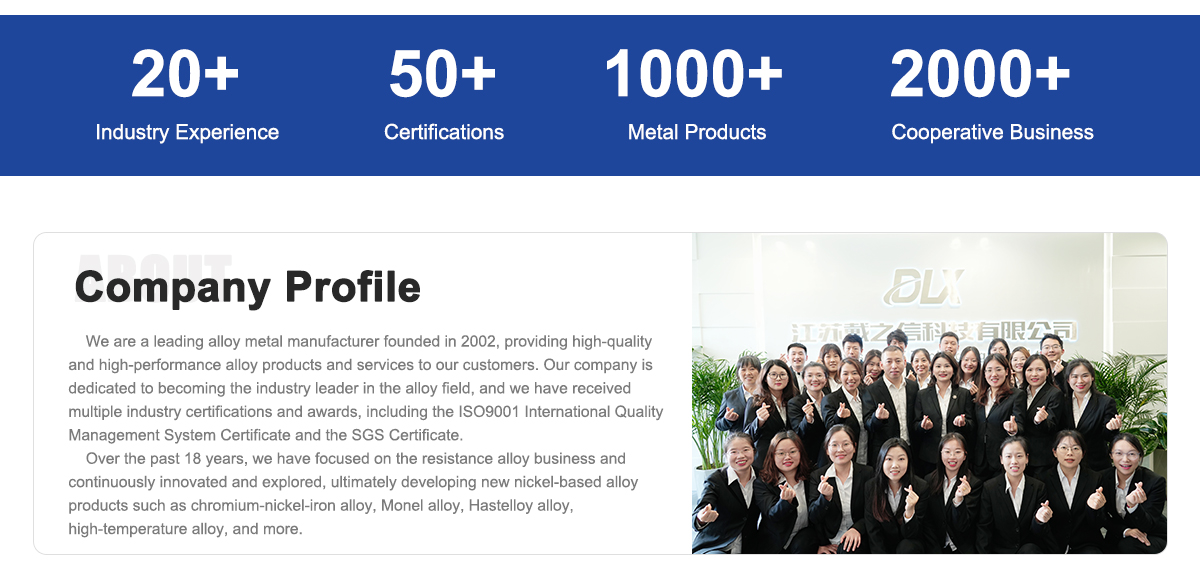
Since 2002, Changzhou DLX Alloy Co., Ltd has been at the forefront of specialty alloy manufacturing. With the rapid growth of the electric vehicle industry, we have dedicated a specialized production line for high-precision bimetallic composite materials. Our 12,000 m² facility is equipped with advanced multi-layer rolling mills and vacuum annealing furnaces. As a professional supplier for the new energy battery supply chain, we focus on delivering materials with atom-level interface control, ensuring that your battery connections are as safe and efficient as possible.
FAQ
Q1: Can you support large-volume and long-term bulk supply of Al/Ni composite sheet?
A: Yes. We maintain production capacity for bulk orders and can establish framework agreements or scheduled deliveries to match continuous battery and ESS manufacturing needs.
Q2: What thickness ratios and sizes are available?
A: Standard Al:Ni thickness ratios include 1:1, 2:1 and 3:1, with total thicknesses typically from 0.1 mm to 0.5 mm (custom available). Widths and lengths can be supplied in coils or cut sheets according to volume requirements.
Q3: How is bonding quality ensured for high-volume production?
A: The material is produced with controlled cold-rolling and annealing processes. Bonding rate is verified (typically 100% by ultrasonic testing) and consistent across large lots to support automated assembly reliability.
Q4: What documentation is provided with bulk shipments?
A: Full material certificates, chemical composition, thickness and bonding inspection reports, plus complete lot traceability are supplied with every order.
Q5: Can the sheet be customized for specific battery tab or busbar designs?
A: Yes. We support custom thickness ratios, widths, surface conditions and pre-slit coils optimized for stamping or laser cutting in high-volume battery production lines.